


Over the past several years flood control projects have become increasingly common across the United States in coastal communities, communities situated along rivers, dams, or other large water bodies, or subject to some other flood risk hazard. The unprecedented and widespread damage from hurricane and storm events such as Hurricane Katrina in New Orleans, Hurricane Sandy in the New Jersey and New York area, and Hurricane Harvey in Houston, Texas have made the general public more aware and concerned about storms and flooding. More importantly, these events have prompted federal legislation and new funding sources to conduct studies and execute flood control projects. These flood control projects fall into one of 2 main categories – structural versus non-structural. This nomenclature can be confusing and may not make sense at first glance. In this blog article, we explore the differences between structural and non-structural flood control projects and gain a better understanding of some common projects in each of these categories.

From Reactive to Proactive
In response to these major storm events in recent years (Hurricane Katrina in 2005, Hurricane Sandy in 2012, and Hurricane Harvey in 2017) and their extensive and unprecedented damage. The federal government began adopting a more proactive approach to coastal storm risk management. Previous federal government and funding sources focused on response – rebuilding and providing aid to communities after one of these major storm events, but there has been a transition to planning ahead of the storm and being more proactive. Congress directed the United States Army Corps of Engineers (USACE) to conduct Coastal Storm Risk Management studies in coastal communities across the United States including places like Miami, FL, St. Augustine, FL, Charleston, SC, Galveston, TX, Norfolk, VA, New York City, and New Jersey just to name a few. A previous CEA Blog Post, Getting Ahead of the Storm explored USACE CSRM studies which you can check out here! LINK The federal government has appropriated additional funding to create FEAM Programs that also aid in preparedness such as the FEMA Building Resilient Infrastructure and Communities (BRIC). The FEMA BRIC program aims to support states, local communities, tribes, and territories as they undertake hazard mitigation projects, to reduce the risks they face from disasters and natural hazards. The BRIC program is based on innovative and collaborative principles to support communities through capability- and capacity-building; encouraging and enabling innovation; promoting partnerships; enabling large projects; maintaining flexibility; and providing consistency. If you are interested in learning more about the FEMA BRIC program and how it can benefit projects in your community check it out on the official FEMA website.
The studies conducted and project types funded through these programs fall into two types: structural flood control projects and non-structural flood risk mitigation projects.
Structural Flood Control Projects
Structural flood control projects are structures that are designed and built specifically to protect communities from rising waters, flooding, storm surge, and wave impact. Structural flood control projects include floodwalls, levees, dikes, dams, reservoirs, retention ponds, and pump stations.
Floodwalls are typically constructed of concrete or masonry with steel reinforcements. A floodwall is designed to a specific height to protect structures that are located at a certain elevation. Older floodwalls typically were typically I-walls, in the sense that the cross-section of the floodwall was in the shape of an I. Newer floodwalls are being constructed in the shape of T-walls where the cross-section of the floodwall looks like an upside-down T. The top of the T shape is the footer of the floodwall and is typically buried underneath the ground (remember we said it’s an upside-down T). This footer provides additional strength and protection against wave action and the impact of debris and boats or barges that may break free during the storm and actually hit the wall. Floodwalls are especially common in urban areas and cities where space is limited. The floodwall is relatively narrow in width and can snake around the perimeter of shorelines to protect the area behind it.
Levees and dikes are large mounds of dirt, specifically engineered to certain heights and widths to protect the communities behind these types of features. The success – or failure of a levee hinges upon the geotechnical engineering and the proper construction of the levee. Geotechnical engineering analysis must be conducted during the design phase of the levee to determine the proper soil types to use and in what thicknesses. During construction, each layer must be compacted incrementally as it is added to certain compaction specifications to ensure the structural integrity of the levee, which ultimately ensures that it will provide the flood protection for which it was designed. The slope of the levee must also be engineered and constructed properly, too steep of a slope or too shallow of a slope will also result in reduced flood protection and/or failure. Levees must be inspected routinely once completed to ensure their integrity and that they are still providing the level of flood protection for which they were designed. A common issue with levees is erosion on their side slopes. Once erosion begins, it can rapidly increase if not addressed and repaired in a timely manner. A levee with eroding side slopes is ripe for failure and can result in the loss of flood protection for the area behind it which it was intended to protect. Levees require a large width of the area to be constructed, so they are more common in less developed areas. However, they provide open space and can sometimes be outfitted with a trail along the top for inspection – which can also double as a recreational amenity for the community to be used as a walking, jogging, or biking trail. Levees also provide an observational point as they are a local high ground from which to observe the water body they provide protection from or the land that they are protecting.
Sometimes a flood control project can be relatively simple, a reservoir or retention pond can provide an area for runoff within a watershed or a small portion of the community during a large storm. The runoff can drain to the pond, settle for a while – usually between 48-72 hours retention time, and then drain in a controlled manner via an outfall from the pond. This controlled drainage approach reduces the risk of flash flooding when large storm events occur and provides a way to manage drainage. Retention ponds can require an amount of space, relative to the benefit they provide and oftentimes the excavation and earthwork required to construct retention ponds is very expensive. However, they can provide flood relief to communities and are also a good option for retrofit applications to solve flooding problems within a community if the space to site one is available.

Non-structural Flood Control Projects
Non-structural flood control projects involve the elevation of homes and other structures, the filling in of basements, and the floodproofing of commercial buildings. But wait? I thought you said these were non-structural projects. This is what I think is the most confusing part of flood control projects, the non-structural projects, and their nomenclature. A good way to understand this is that non-structural projects involve modifications to existing structures to reduce the risk from future floods.
Elevations
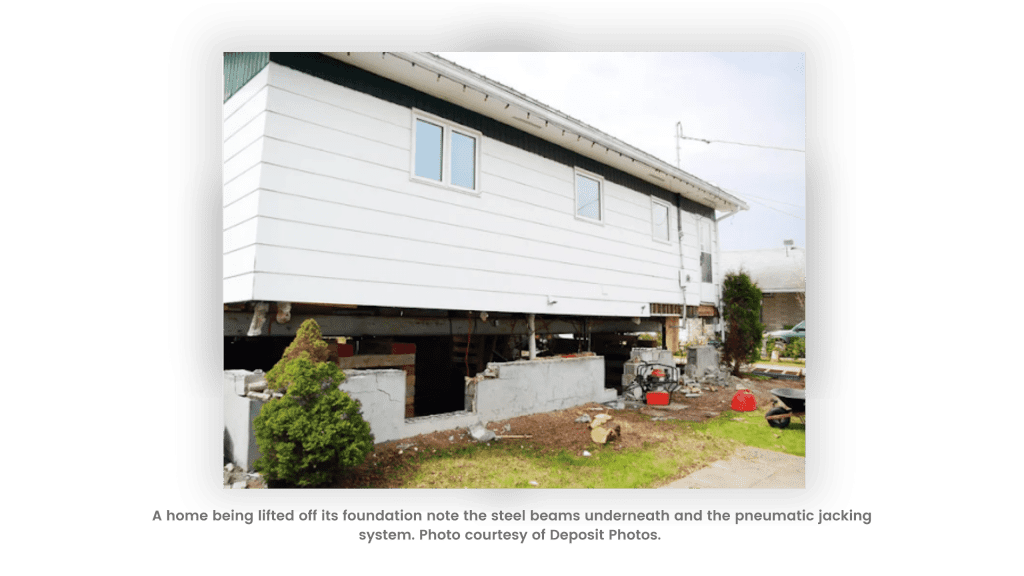
Elevations involve elevating homes and other structures to heights above their current elevation with the idea being to prevent floodwaters from entering the structure during future floods. Typically this requires the occupants to temporarily move out, pack their contents and belongings and remove them from the building. All the utilities such as water, sewer, electric, natural gas, and telecommunication are disconnected temporarily from the structure. A system of jacks and rails is then placed underneath the foundation of the structure and pneumatic systems are used to raise the jacking system to the new, higher elevation. This process separates the structure from its foundation and raises the structure. Once that elevation is reached a new concrete block foundation is built for the home to rest on, the utilities are reconnected, and the jacking system is removed. Accommodations and modifications are built to access the structure at its new elevation such as steps, porches, and ramps. Licensed structural engineers, inspectors, and other experts are involved throughout the design and construction process and carefully watch each part of this process. Once the structure is declared safe for occupancy, owners and tenants can move back in and enjoy increased protection from future flood events provided by the new height of the structure. A lot of engineering and coordination needs to go into this process as it can be very dangerous if not done correctly. Also consult licensed structural engineers, building officials, and licensed contractors with expertise in structural elevations prior to attempting any project.
Basement fills
Basement Fills refer to filling in basements with dirt, grave0,l or other fill materials such that the structure no longer has a basement. Sometimes this is done in conjunction with an elevation of the structure but not always. Basement Fills can become controversial due to the perceived loss of living or storage space by the property owner. But if the space was subject to flooding would you really want to have that area anyway? Basement fills the need to be specifically designed by geotechnical engineers and structural engineers to ensure the safety and success of the project.
Commercial Floodproofing
Floodproofing is another type of non-structural measure. Floodproofing involves placing deployable or removable panels, in front of building openings such as pedestrian doors or large bay doors (think like a fire station door) to prevent water from entering. The pop-up type panels can also be installed along streets to create a flood barrier that can be deployed as needed. Floodproofing is only appropriate for commercial buildings per National flood Insurance Program (NFIP) regulations at the time of this article. Hence, floodproofing would not be appropriate for a single-family home.
How Flood Control Projects Impact Your Civil Engineering Career
While flood control projects are categorized in the water resources area of civil engineering, licensed civil engineers from all disciplines – structural, geotechnical, and water resources, are crucial to the success of these types of projects. These flood control projects will be increasing in complexity and scope as climate change and sea level rise continue to impact civil engineering making career opportunities and new challenges available for you to explore! We are here to help you every step of the way towards passing your Civil FE and PE Exams. Check out the Ultimate Civil PE Exam Breadth and Depth Review Courses here. We’ll see you there!
Do you have a topic or interesting project that you would like us to cover in a future blog post? Submit it to us here. We would love to hear from you!
__________________________________________________
Author: Matt Fanghella, PE, CFM
CEA Resources:
The Ultimate Civil FE Review Course – https://civilfereviewcourse.com
The Ultimate Civil PE Review Course – https://civilpereviewcourse.com
FE and PE Practice Exams – https://civilengineeringacademy.com/exams
Free Facebook Community – https://ceacommunity.com
YouTube Channel – https://www.youtube.com/channel/UCPeFLBZ2gk0uO5M9uE2zj0Q
Newsletter – https://civilengineeringacademy.com/newsletter
Instagram – https://www.instagram.com/theceacademy
Twitter – https://twitter.com/civilengacad
Reach out to Isaac – [email protected]